Ganesh Chaturthi was meant to bring people together.
Today, in many places, we need to ask an uncomfortable question: are we really celebrating Lord Ganesha, or have we turned His festival into a competition of size, sound, money, political influence and public display?
This is not a question against Hinduism. It is a question we Hindus ourselves should be willing to ask, because questioning a harmful practice is not questioning faith.
One Ganesha brought a community together. Why do we need one on every street?
Public Ganesh celebrations historically became associated with community participation and social unity. Look at many neighbourhoods today. One colony has several idols. Adjoining streets run separate pandals. Groups compete over the tallest idol, the biggest decoration, the loudest DJ, the longest procession, the largest laddu auction and the biggest crowd.
If ten streets need ten Ganeshas, are we coming together, or dividing ourselves into ten groups? And every additional pandal means more electricity, decorations, flex banners, plastic, traffic disruption, processions and, eventually, more waste.
We cut trees to make way for the God we worship
- A tree obstructs the procession? Cut the branches.
- An electrical wire is too low? Cut or move it.
- A streetlight is in the way? Damage or dismantle it.
- A median or road divider creates a problem? Break or alter it.
Roads, cables, streetlights, trees and other public assets belong to everyone. Who gave any religious procession the right to damage them? And who pays to restore them? The public.
We worship Ganesha and then leave the bill to taxpayers
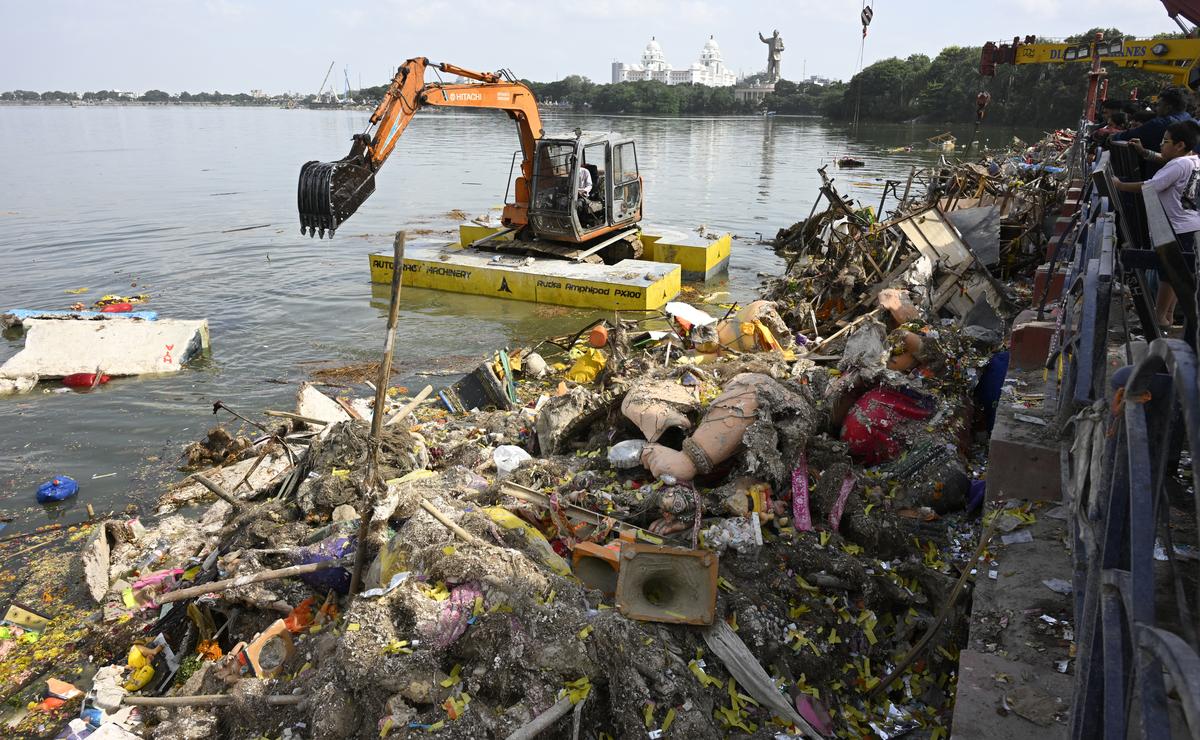
The expenditure doesn't end with the pandal. Think about the public machinery required for major immersion operations:
- Cranes and heavy machinery
- Police and traffic deployment
- GHMC sanitation workers
- Emergency services and medical teams
- Barricades and road diversions
- Lighting and temporary infrastructure
- Excavators and waste collection vehicles
- Boats and immersion arrangements
- Electricity-related works
- Thousands of personnel working extended hours
And finally, tonnes of material that must be removed, transported and processed.
Some public spending for crowd safety is unavoidable whenever very large gatherings occur. But shouldn't we still ask how much public money is spent every year because celebrations have become larger, more fragmented and harder to manage? Why shouldn't organisers bear more responsibility for the additional costs they create? Why should taxpayers repeatedly pay for avoidable pollution, damage and cleanup?
There is also a human cost that rarely makes the headlines: workers who handle immersion and sanitation, and injuries, sometimes fatal, linked to overloaded trucks, electrocution near overhead wires and crushes at crowded immersion points. That toll deserves the same attention as the financial one.
We worship nature and immerse chemicals into it
This contradiction should trouble every devotee. We pray to Ganesha. Then painted idols, decorations and associated waste enter our lakes and immersion facilities.
Even an idol marketed as "clay" deserves scrutiny if it carries synthetic paints, glitter, plastic decoration or chemical coatings. The damage is not abstract. It shows up as degraded lakes, contaminated water near immersion points, harm to aquatic life, and clean-up work that takes months or years to undo.
Why can't natural clay, natural colours and genuinely eco-friendly decoration become the norm rather than the exception?
Annadanam is noble. Plastic annadanam isn't.
Feeding people is one of our most beautiful traditions. But look at what can remain after a large annadanam: disposable plates, plastic glasses, spoons, water bottles, carry bags, sachets and food waste.
A meal lasts ten minutes. Some of its waste can remain in the environment for decades. Can an act of service still be called responsible if somebody else has to clean up mountains of waste afterward?
Why can't reusable utensils, steel glasses, leaf plates and proper waste segregation become compulsory for large pandals?
When did devotion need a DJ?
Why does worship require deafening music? And not necessarily devotional music: movie songs, mass songs, dancing on moving trucks, high-powered sound systems rolling through crowded neighbourhoods.
If DJs are restricted or banned, why does enforcement sometimes appear ineffective? What about infants, senior citizens, patients, students, animals and ordinary residents, who have an equal right to peace? Sustained exposure to extreme noise can damage hearing. It is not a trivial inconvenience.
Then come crackers, confetti and explosions of waste
Crackers explode. Plastic and paper confetti fly everywhere. Within seconds, roads can be covered with litter. The procession moves ahead. Someone else cleans it up.
We seem to have created a simple formula: celebrate privately, pollute publicly, clean with public money. How is that acceptable?
Traffic laws don't disappear during a festival
- Wrong-side driving
- Overloaded vehicles and people hanging from trucks
- Vehicles stopping in the middle of roads
- Processions occupying entire carriageways
- Blocked junctions and illegal parking
- Emergency vehicles struggling to pass
Normal traffic rules suddenly appear optional. Does devotion give anyone immunity from civic responsibility? A person trying to reach a hospital, airport, railway station or workplace has rights too.
Even immersion rules become negotiable
Every year we hear about restrictions on PoP idol immersion and controversy over immersion in Hussain Sagar. Then come negotiations, political pressure, practical difficulties, enforcement challenges and last-minute arrangements.
The public eventually learns a dangerous lesson: don't worry about the rule, create enough pressure and somebody will find a workaround. A government cannot build respect for law this way. Either establish clear, environmentally responsible rules well in advance and enforce them consistently, or stop pretending there is a ban.
The laddu auction, and the shawl
Laddu auctions can raise money for community causes, and many organisers genuinely use the proceeds well. But we should still ask what happens when the price, the bidder, the political connections and the publicity become the main story. ₹10 lakh. ₹20 lakh. ₹40 lakh. ₹1 crore. At what point does devotion become a display of wealth and influence?
Would Ganesha be less pleased if that same money quietly funded a government school, restored a lake, planted trees or fed families without cameras watching?
The same question applies, in a smaller but constant way, to the shawl culture around pandals. A politician arrives: shawl. An organiser comes on stage: shawl. A local leader visits: shawl. Another guest arrives: another shawl. Photographs are taken, videos are posted, names are announced. Some pandals reportedly spend tens of thousands of rupees, sometimes around ₹50,000, on shawls and felicitation ceremonies alone.
Why should individuals standing before Ganesha need to be repeatedly honoured and publicly praised? And what happens to those hundreds of shawls afterward? Most recipients already have many. They are rarely needed, and many end up unused in cupboards or as waste.
Think about the contradiction. We collect donations in Ganesha's name and then spend part of that money honouring ourselves. That ₹50,000 could:
- support a government school,
- plant and maintain trees,
- provide reusable utensils for annadanam,
- help clean a lake,
- support a poor student's education, or
- provide medical assistance to someone who genuinely needs it.
Instead, it can go towards ceremonial shawls whose purpose may last only as long as a photograph.
Politicians should consider refusing them. Organisers should stop budgeting for them. Guests can simply say: "Please don't honour me with a shawl. If you want to honour me, use that money for a social or environmental cause."
Imagine the message if every politician, public representative, sponsor and community leader visiting a Ganesh pandal followed that principle. No shawl. No unnecessary bouquet. No personal glorification. No waste. Just fold your hands before Ganesha and move on.
A Ganesh pandal should be a place where Ganesha is celebrated, not a stage where human beings compete to be celebrated in front of Him. This culture can change immediately, and it doesn't require a government order. It only requires humility.
Politicians need to answer
Politicians of every party visit prominent pandals. Photographs are taken, garlands exchanged, speeches made, posts uploaded. But leadership is tested when popular practices conflict with the public interest.
Will political leaders support the same noise restrictions, environmental rules, traffic laws and public-property protections during a major religious celebration that they expect citizens to follow on an ordinary day? If a rule is scientifically and legally justified, why should the size or influence of a crowd determine whether it is enforced?
Government needs to answer
- Why announce restrictions that cannot be enforced?
- Why permit oversized idols and vehicles that cannot safely pass through existing roads and electrical infrastructure?
- Why should public assets be modified or damaged to accommodate them?
- Why aren't organisers held financially accountable for identifiable damage and extraordinary cleanup?
- Why isn't environmental compliance built into permissions before the pandal is erected?
And most importantly: where is the publicly available calculation of what the entire operation costs taxpayers? Police deployment, sanitation, cranes, transport, temporary infrastructure, waste handling, repairs, electricity works, emergency services. Publish it. Let citizens see the true cost.
Organisers need to answer
Before asking for a bigger idol next year, ask:
- Did we generate less waste?
- Did we avoid single-use plastic?
- Did we protect trees?
- Did we obey sound limits?
- Did we prevent littering?
- Did we avoid damaging public infrastructure?
- Did our procession obey traffic rules?
- Did we leave our street cleaner than we found it?
- Did our celebration inconvenience thousands of people unnecessarily?
Why should success be measured by the height of the idol instead of the responsibility of the celebration?
Media needs to answer too
The media enthusiastically reports "the tallest Ganesha," "the most expensive laddu," "the biggest procession," "record crowds," "massive immersion." But where are the equally prominent stories asking:
- How much waste was generated?
- How much did government spend?
- How many trees were damaged, and how much public property needed repair?
- How many noise and traffic violations occurred?
- How much PoP entered immersion facilities?
- How many people were injured or killed?
When the media glorifies scale without questioning consequences, doesn't it encourage the race to become even bigger next year?
And finally, devotees need to answer
This is perhaps the most important question. Lord Ganesha represents wisdom, yet we knowingly repeat practices that harm our surroundings. He is Vighnaharta, the remover of obstacles, yet we block roads and create obstacles for thousands of others.
- We pray for health while creating noise and air pollution.
- We worship nature while cutting trees.
- We seek clean water while contaminating water bodies.
- We offer annadanam and leave disposable waste behind.
- We ask Ganesha to remove difficulties from our lives while leaving the government and sanitation workers to remove the mess our celebration created.
Isn't there something fundamentally contradictory here?
A fair word about livelihoods
Idol-making and pandal work are livelihoods for many artisans and workers. Any move toward more responsible celebrations has to reckon honestly with that, not wish the industry away. The aim is not to shrink devotion, but to redirect the same economic activity toward safer materials and practices. Potter communities and eco-idol initiatives, including some in Hyderabad, have shown this can be done without losing income or tradition.
The festival doesn't need to become smaller in spirit. It needs to become greater in responsibility.
Imagine something different
- Fewer community idols bringing larger groups together
- Natural clay and natural colours
- Reasonably sized idols
- No DJs and no crackers
- No tree cutting and no public-property damage
- No single-use plastics; reusable utensils for annadanam
- No shawls and no personal glorification
- Strict traffic discipline
- Organisers paying for extraordinary cleanup and any damage they cause
- Transparent government expenditure
- Immersion rules announced months in advance and enforced without exceptions
And instead of competing for the tallest idol, communities competing for the cleanest, quietest, safest and most sustainable Ganesh festival.
That wouldn't weaken Hinduism. It could demonstrate its values far more powerfully.
So before planning an even bigger celebration next year, everyone involved should ask one simple question: people, organisers, politicians, government, police, media, religious leaders.