Why Do Manholes Overflow When It Rains? The Hidden Truth Beneath Streets of Hyderabad
By Venkat Ankam,
Dha3R NGO
What we know is manholes overflow when they are clogged with garbage or silt. While that can happen on any day, it doesn’t explain a critical question: Why do almost all manholes suddenly overflow whenever it rains in Hyderabad? How does rainwater enter underground drainage lines?
The answer is surprisingly simple—and deeply disturbing.
Rainwater is not supposed to enter sewage drains.
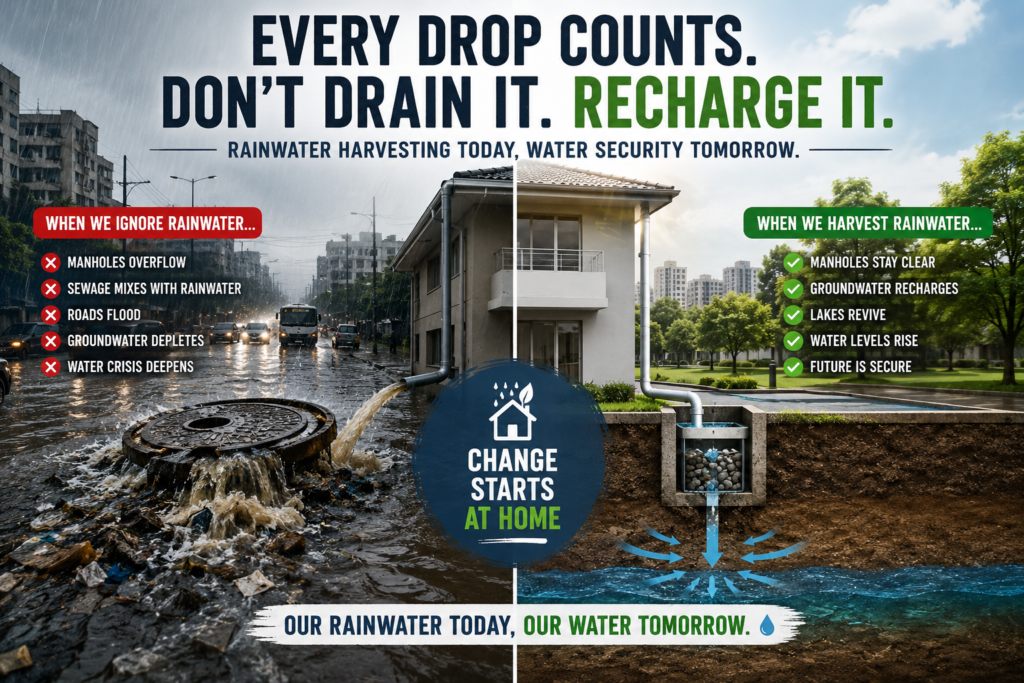
Yet across Hyderabad, thousands of houses and apartments have illegally or carelessly connected rooftop rainwater pipes directly to the underground drainage network instead of rainwater harvesting (RWH) pits. During every heavy rain, millions of litres of clean rainwater are dumped into sewage lines that were designed only for wastewater. The result? Overflowing manholes because heavy silt carried from every manhole because huge water pressure, flooded roads, sewage mixing with rainwater, damaged infrastructure, polluted lakes, and an unbearable burden on civic agencies.
This is not just an engineering problem. It is a citizen problem, a governance problem, and a water security problem.
Only 5% Are Doing It Right
Did you know that only around 5% of houses effectively use their rainwater harvesting pits?
Our team conducted a door-to-door survey across individual houses, apartments, and commercial complexes in the LB Nagar area. The findings were both interesting and shocking.
What We Discovered
1. New apartments are mostly compliant—but only on paper
Most newly constructed apartments have functioning rainwater harvesting pits because they are mandatory for obtaining building permissions.
Unfortunately, in many cases, compliance ends there. Maintenance is often neglected after occupancy.
2. Older apartments have abandoned their RWH systems
This was the most common observation.
Many apartments constructed just a few years ago originally had rainwater harvesting pits. Today:
- Rainwater pipes have been diverted directly into drainage lines.
- RWH pits have been sealed permanently with concrete slabs to create parking space or avoid maintenance.
- Residents have no idea whether the system underneath even exists anymore.
- Apartment associations often blame builders for poor construction and simply abandon the system instead of fixing it.
The consequences are invisible until the next water crisis arrives.
3. New individual houses have RWH pits only for namesake
Many recently built houses technically have rainwater harvesting pits because they are required for approvals.
But the rainwater pipe is quietly connected to the drainage line instead.
Why?
People gave many reasons:
- “The pit may weaken the building foundation.”
- “Water near the house will damage beams.”
- “The pit will become dirty and smell.”
- “Maintenance is difficult.”
- “Water should flow outside according to Vastu.”
- “The pit is in the wrong location.”
- “Nobody checks anyway.”
- “Nobody is doing it. Why should I?”
When approvals can be obtained without proper inspection, compliance becomes merely another formality.
4. Most older individual houses have no working RWH system
Many houses either never constructed rainwater harvesting pits or disconnected them long ago.
Their belief is simple:
“There was no need for rainwater harvesting pits when we constructed our house 15 years ago”.
“Providing water is the government’s responsibility. Recharging groundwater is not ours.”
Others believe:
“If I recharge groundwater, my neighbours will benefit more than me.”
Ironically, everyone draws water from the same underground aquifer.
Groundwater does not recognize compound walls.
5. Commercial Buildings, Schools and Institutions Are No Better
The problem is not limited to houses and apartments.
Many commercial buildings, office complexes, schools, colleges, hospitals, function halls, Garages and other institutions either do not have functional rainwater harvesting systems or have completely neglected them.
Despite having large rooftops that can capture lakhs of litres of rainwater every year, much of this water is simply diverted into stormwater drains or, worse, sewage lines.
In many cases:
- RWH pits exist only on approved building plans, not in reality.
- The pits are clogged, damaged or buried under new construction.
- Nobody knows whether they are functioning because they are never inspected.
- Facility managers prioritize parking, landscaping and maintenance convenience over groundwater recharge.
- Rainwater harvesting is viewed merely as a compliance requirement rather than a long-term investment in water security.
Ironically, many schools teach students about environmental conservation, water scarcity and sustainability inside classrooms, while their own campuses fail to harvest the rain falling on their roofs.
Commercial establishments consume enormous quantities of water every day, yet many continue to discharge rainwater and RO reject water into drainage lines instead of recharging the ground. Every commercial building, school, hospital and office has a responsibility to harvest rainwater and manage water sustainably.
Water conservation cannot remain just a CSR activity or a lesson in textbooks. It must become a mandatory, measurable practice across every commercial property and institution.
The Biggest Misconceptions
During our survey, we repeatedly heard several myths.
- Rainwater harvesting damages foundations.
- The pits always become mosquito breeding grounds.
- Rainwater harvesting creates foul smell.
- It’s our builder’s mistake not ours.
- It is too expensive.
- It requires frequent maintenance.
- My borewell is already deep enough.
- Municipal water is sufficient.
- Rainwater harvesting is only useful in villages.
- One house cannot make any difference.
- Government should solve the problem.
- My neighbour doesn’t have one, so why should I?
- Water flowing into the road is harmless because it eventually reaches a lake.
Almost every one of these beliefs is incorrect.
A properly designed rainwater harvesting system is safe, inexpensive, requires minimal maintenance, prevents urban flooding, and significantly improves groundwater recharge.
The Cycle We Never Learn From
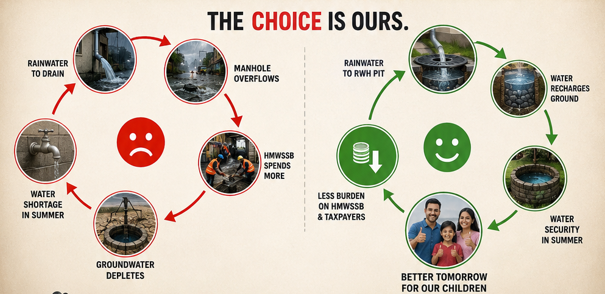
Every summer we panic.
Borewells fail.
Municipal water becomes irregular.
Tankers become expensive and unavailable.
Residents desperately search for water.
Then the monsoon arrives.
All rainwater from roofs is diverted into drainage system.
Manholes overflow. Streets Flood with Sewage water. Lakes are filled with Sewage + Garbage
We spend crores of taxpayers money in cleaning drains, building new nalas to stop flooding in streets and stop diverting sewage to lakes. We lay rainwater pipes and connect to lakes. Sewage water reaches through pipes instead of rainwater. Even if there is no rain, water (Sewage ?) comes through the pipe.
Groundwater slowly recovers through sewage water stored in lakes and through broken manholes system. It’s dirty and unhealthy.
Everyone forgets.
Nothing changes.
The cycle repeats.
But every year, the problem becomes worse.
The Silent Groundwater Disaster
Ten years ago, drilling a borewell to 200–300 feet was common.
Today, drilling to 1,000–1,800 feet has become normal in many areas.
Every new deep borewell lowers the groundwater table even further.
One person’s deeper borewell forces neighbours to drill even deeper.
Eventually, entire colonies compete to extract the last remaining groundwater.
This is not sustainable.
We Are Throwing Away Free Water
Hyderabad receives enough rainfall every year to recharge a significant portion of its groundwater.
Instead of allowing this precious resource to soak into the earth, we rapidly channel it into drains, sewage networks, nalas and polluted lakes.
Later, we spend crores of rupees extracting groundwater, transporting water through tankers, drilling deeper borewells and expanding water supply infrastructure.
We are literally paying to solve a problem we create ourselves.
The Choice is ours.
Where Is HMWSSB?
Rainwater harvesting is mandatory.
But where is the enforcement?
Where are the inspections?
Where are the penalties for disconnected systems?
Where are the public awareness campaigns?
How many functioning RWH systems have been audited?
How many fines have actually been imposed?
Despite the legal requirement, very few citizens have ever heard of anyone being penalized for having a non-functional rainwater harvesting system.
Enforcement appears almost non-existent.
NGOs Are Doing What Government Should Also Be Doing
Across Hyderabad, several NGOs, resident welfare associations, volunteers and corporate CSR programs are creating awareness, raising funds and constructing rainwater harvesting pits.
Citizens are volunteering their weekends to educate communities.
Yet these isolated efforts cannot solve a city-wide crisis.
Without active government participation, mass awareness, regular inspections, incentives and enforcement, the impact will remain limited.
What Needs to Change Immediately
- Audit every existing rainwater harvesting system—not just during construction approvals.
- Disconnect illegal rainwater connections entering sewage lines.
- Make annual RWH certification mandatory for apartments.
- Impose meaningful penalties for non-functional systems.
- Provide subsidies and technical assistance for retrofitting older buildings.
- Launch city-wide awareness campaigns through schools, colleges, media and resident welfare associations.
- Publish ward-wise compliance reports to encourage accountability.
- Encourage every colony to adopt groundwater recharge as a community movement rather than an individual responsibility.
This Is No Longer Just About Water
Rainwater harvesting is connected to everything:
- Water security
- Urban flooding
- Overflowing manholes
- Sewage pollution
- Dry lakes
- Falling groundwater levels
- Rising tanker costs
- Public health
- Climate resilience
- Future generations
Every drop of rainwater that enters a sewage drain instead of the ground is a lost opportunity.
Every disconnected rainwater harvesting pit pushes Hyderabad closer to another water crisis.
The solution is not complicated.
The rain already falls.
We simply need to stop wasting it.
The next time you see an overflowing manhole during rain, ask yourself one question:
Is the problem the rain… or the way we have chosen to manage it?
The future of Hyderabad’s water does not depend only on the government.
It depends on every rooftop.
It depends on every rainwater pipe.
And it depends on every one of us.